Annals of Family Medicine: Bleeding Risk Exceeds Clotting Risk in Patients With Cancer Near the End of Life
PR Newswire
PROVIDENCE, R.I., April 1, 2026
Most patients taking blood thinners continued treatment until death or stopped only shortly beforehand, study finds
PROVIDENCE, R.I., April 1, 2026 /PRNewswire/ -- Bleeding events were far more common than clotting events among patients with cancer in the last phase of life, yet most patients taking blood-thinning medications continued treatment until death or stopped only shortly beforehand, according to a study in Annals of Family Medicine.
Blood thinners, also called antithrombotic medications, help prevent blood clots but also increase the risk of bleeding, which can be distressing and burdensome for patients. Clinicians and families often face difficult decisions about whether to continue these medications as patients approach the end of life.
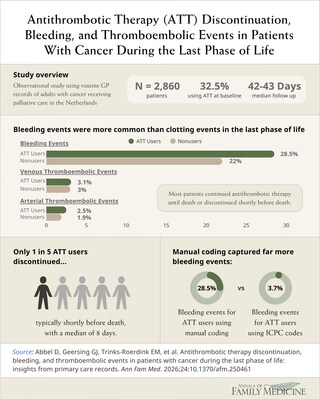
Researchers examined bleeding, blood thinner use, and related events in patients with cancer during the last phase of life using routine general practitioner (GP) records from 2018 to 2022 in the Netherlands. They analyzed data from 2,860 adults starting when the GP first registered palliative care and reviewed records until death or their last GP visit. The median observation period was about six weeks.
At the start of this period, about one-third of patients were using blood thinners. Most continued treatment. Only about one in five discontinued therapy, typically shortly before death, with a median of eight days between discontinuation and death. Recognition of the terminal phase was the most commonly recorded reason for stopping treatment. Bleeding was recorded in 28.5% of patients using blood thinners and 22.0% of nonusers. Venous clots were far less common, occurring in 3.1% of users and 3.0% of nonusers. Researchers found that bleeding events were frequently missed in diagnosis codes. Manual review of clinical notes identified bleeding in 28.5% of blood-thinner users, while diagnosis codes captured 3.7%.
Bleeding events outnumbered clotting events in both patients taking blood thinners and those not taking them, yet most patients continued these medications until death or shortly before death. The findings describe how antithrombotic therapy is used in primary care for patients with cancer during the last phase of life and highlight the need to weigh the benefits and harms of continuing these medications.
Article Cited:
D. Abbel, MSc; G. J. Geersing, MD, PhD; E. M. Trinks-Roerdink, MD, PhD; S. J. Aldridge, PhD; A. Edwards, MD, PhD; E. C. T. Geijteman, MD, PhD; J. Goedegebuur, MD; J. Gussekloo, MD, PhD; E. K. Kempers, BSc; F. A. Klok, MD, PhD; M. J. H. A. Kruip, MD, PhD; I. Mahé, MD, PhD; S. P. Mooijaart, MD, PhD; S. Noble, MD, PhD; A. G. Ording, MSc, PhD; J. E. A. Portielje, MD, PhD; S. Szmit, MD, PhD; M. Søgaard, DVM, PhD; S. Trompet, MSc, PhD; S. C. Cannegieter, MD, PhD; and C. J. van den Dries, MD, PhD
Annals of Family Medicine is an open access, peer-reviewed, indexed research journal that provides a cross-disciplinary forum for new, evidence-based information affecting the primary care disciplines. Launched in May 2003, Annals of Family Medicine is sponsored by six family medical organizations, including the American Academy of Family Physicians, the American Board of Family Medicine, the Society of Teachers of Family Medicine, the Association of Departments of Family Medicine, the Association of Family Medicine Residency Directors, and the North American Primary Care Research Group. Annals of Family Medicine is published online six times each year, charges no fee for publication, and contains original research from the clinical, biomedical, social, and health services areas, as well as contributions on methodology and theory, selected reviews, essays, and editorials. Complete editorial content and interactive discussion groups for each published article can be accessed for free on the journal's website, www.AnnFamMed.org.

 View original content to download multimedia:https://www.prnewswire.com/news-releases/annals-of-family-medicine-bleeding-risk-exceeds-clotting-risk-in-patients-with-cancer-near-the-end-of-life-302731477.html
SOURCE Annals of Family Medicine


