Artmarket.com: The Artprice Manifesto: 22 Rules for a Regulated and Transparent Art Market in the Age of AI
PR Newswire
PARIS, May 14, 2026
Artificial intelligence is redistributing the value of information at an unprecedented pace
PARIS, May 14, 2026 /PRNewswire/ -- We are living through one of those defining periods. Artificial intelligence is redistributing the value of information at an unprecedented pace. Synthetic data now makes up the majority of the Internet, having surpassed Peak Data in 2024 (a phenomenon reflecting a saturation of the high-quality data available to train AI LLMs), reaching a point where AI slop (AI-generated video or photo content) now blurs the line between documented fact and algorithmic reconstruction. In an information-saturated world under extreme strain—facing the greatest energy shock the global economy has ever encountered, a risk of an extreme food crisis according to the UN, structural geopolitical uncertainties, and market tensions redefining asset allocation behaviors—the quality of the source has never mattered more.
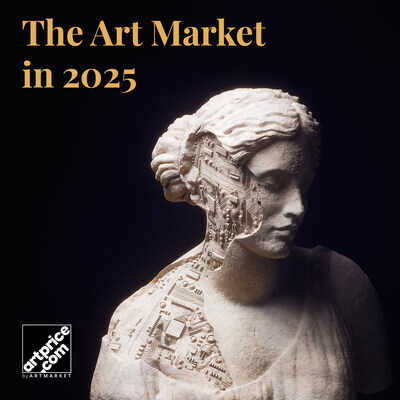
For 27 years, Artprice has patiently built what can be likened to the Library of Alexandria of the Art Market: a physical and documentary memory tracing back to the manuscripts mapping the birth of the market in Europe and the United States from 1700, all the way to the millions of artworks exchanged every year in auction houses worldwide. This represents over 210 million paper or parchment pages meticulously preserved as physical manuscripts and catalogs. It is a living, irreplaceable archive that exists nowhere else in the world in both physical and digital formats with such exhaustiveness:
907,100 artists, 30 million indices and auction prices since 1987, and 1.39 million lots referenced over the past 12 months across 180 databases.
It is within this logic of the Art Market's exponential acceleration—driven by public online auctions and expansion across all seven continents—that Artprice News was born in September 2025. As Artprice by Artmarket's real-time news agency, it has partially absorbed the columnists, editors, and the prestigious 25-year documentary archive of leading contributors from ArtMarket Insight, a specialized global news agency founded in 2001 in a weekly format. Artprice News boasts 24/7 global coverage across 122 countries and in 11 languages.
This strategic rollout represents a major paradigm shift: Artprice is transitioning from a weekly schedule with its ArtMarket Insight® news agency—which will continue to operate—to a continuous, daily global news feed with Artprice News in 122 countries and 11 languages, alongside its longstanding partners Cision PR Newswire and X.
Today, Artprice by Artmarket is speaking out to clarify its moral duty and the core values of its parent company, Server Group—a pioneer in the Internet, databases, and Artificial Intelligence since 1987—which also define the alignment of Artprice's proprietary and vertical AIs.
Continuously listed on the Euronext regulated market, Artprice by Artmarket fully embraces the obligations that come with access to regulated financial markets: transparency, rigor, and consistency between commitments and actions. Following the delisting via public buyout offers (OPR) of two Art Market-related companies—most notably Sotheby's—Artprice by Artmarket is now the only continuously listed company on a regulated market worldwide dedicated to global Art Market information. This effectively establishes it as the foundational benchmark for this entire ecosystem.
As the global leader in Art Market information and the publisher of authoritative benchmark reports on the global Art Market for nearly 30 years, connected to 7,200 partner Auction Houses via its dedicated and secure Intranet, Artprice does not merely provide data: it produces a framework of understanding and trust that influences market players, valuations, and international capital flows, driven notably by its two proprietary, vertical AIs, Intuitive Artmarket® and Blind Spot®.
In our current environment of accelerated globalization, digitized transactions, and the rise of AI applied to cultural data, failing to take a stand would leave the field wide open to opacity, rumors, and biased practices. This would be a dereliction of duty toward the market, institutions, collectors, and shareholders.
This 22-rule manifesto is Artprice by Artmarket's answer to this responsibility, to its moral duty, and to the intangible values of its AI alignment.
Through it, we are publicly formalizing a clear and resolute stance: to champion documentary memory, the traceability of artworks, the transparency of Art Market data, and the rigorous integration of art history, art economics, and the sociology of the Art Market, as the prerequisites for a more legible, fair, and responsible market.
This manifesto is the benchmark document that details its mission, the stakes of data sovereignty, and its responsibility toward the world's artistic heritage.
The Artprice Manifesto: 22 Rules for a Regulated and Transparent Art Market
- The Art Market needs memory. Without exhaustive archives, traceability, and a public historical record, there can be no lasting trust, fair pricing, or collective intelligence.
- Qualified Art data is not a luxury. It is the minimal infrastructure for a global market that has grown too vast, too fast, and too opaque to continue operating on intuition alone. The Art Market is no longer the exclusive preserve of the West; it is experiencing rapid growth in the Global South.
- An image is not enough. An artwork also lives through its provenance, exhibition history, bibliography, public auction results, circulation, and critical reception.
- Cultural capital deserves the same analytical rigor as other asset classes. Measuring the market does not desecrate Art; it gives it a common language.
- Opacity is not a mark of elegance. Too often, it is merely a class privilege, an insider's advantage, or a way to maintain information asymmetry.
- The primary duty of an Art Market infrastructure is to reduce this asymmetry. To make visible what was scattered, connect what was fragmented, and contextualize what was raw.
- Transparency does not destroy desire. On the contrary, it allows trust, comparison, and conviction to be built upon much more solid foundations.
- Art history and Art economics must no longer be separated. The former provides meaning; the latter provides measurement; together, they make the market intelligible.
- Digital technology is not meant to replace the human eye. It must extend expertise, document rarity, inform decision-making, and preserve memory.
- Every economic market eventually comes to resemble its information system. A poorly documented market breeds rumors; a well-documented market fosters accountability and transparency.
- The Art world can no longer claim universality while remaining illegible to the vast majority. Access to information is a prerequisite for its true openness, notably to the countries of the Global South.
- Artists need documented visibility, not just media visibility. A career is also built within databases, biographies, indices, archives, and comparables.
- Collectors do not merely buy Artworks; they arbitrate between history, rarity, quality, liquidity, prestige, and long-term value. They have a legitimate right to structured information.
- Auction Houses, Galleries, Collectors, Experts, Institutions, Insurers, Museums, Customs Officials, Banks, and Financial Institutions all belong to the same informational ecosystem. When data flows better, the entire market gains in maturity.
- The globalization of the Art Market demands continuous mapping. Capitals shift, scenes emerge, hierarchies change, and narratives are rewritten.
- France, Europe, and their cultural institutions must not surrender control over their artistic data. Cultural sovereignty is also achieved through databases, indices, and platforms.
- Artificial intelligence is only as valuable as the quality of the datasets it queries. In Art, as elsewhere, an AI algorithm without robust archives produces nothing but an illusion of knowledge.
- True technological progress in the Art Market is not about noise. It is the ability to transform millions of scattered signals into understandable and actionable benchmarks.
- Prices do not tell the whole story, but they do tell a story. To ignore them on principle is to allow commentary to replace analysis and posturing to replace observation.
- Trust in the 21st-century Art Market rests on proof, documentary depth, and high-speed access to relevant information at a low cost.
- An artwork is not a mere commodity, but refusing to acknowledge that it circulates within a global market does not elevate the debate; it only makes it less honest.
- Artprice champions a simple conviction: in a world saturated with images, value will belong to those who know how to connect the artwork, history, data, the human element, proprietary AI—retaining full copyright ownership and bearing full responsibility for its data—and the Art Market.
Copyright 1987-2026 thierry Ehrmann www.artprice.com - www.artmarket.com
Artprice's econometrics department can answer all your questions relating to personalized statistics and analyses: econometrics@artprice.com
Find out more about our services with the artist in a free demonstration: https://artprice.com/demo
Our services: https://artprice.com/subscription
About Artmarket.com:
Artmarket.com is listed on Eurolist by Euronext Paris. The latest TPI analysis includes more than 18,000 individual shareholders excluding foreign shareholders, companies, banks, FCPs, UCITS: Euroclear: 7478 - Bloomberg: PRC - Reuters: ARTF.
Watch a video about Artmarket.com and its Artprice department: https://artprice.com/video
Artmarket and its Artprice department were founded in 1997 by thierry Ehrmann, the company's CEO. They are controlled by Groupe Serveur (created in 1987). cf. the certified biography from Who's Who In France©:
Artmarket is a global player in the Art Market with, among other structures, its Artprice department, world leader in the accumulation, management and exploitation of historical and current art market information (the original documentary archives, codex manuscripts, annotated books and auction catalogs acquired over the years) in databanks containing over 30 million indices and auction results, covering more than 901,000 artists.
Artprice Images® allows unlimited access to the largest art market image bank in the world with no less than 181 million digital images of photographs or engraved reproductions of artworks from 1700 to the present day, commented by our art historians.
Artmarket, with its Artprice department, constantly enriches its databases from 7,200 auction houses and continuously publishes art market trends for the main agencies and press titles in the world in 121 countries and 11 languages.
Artmarket.com makes available to its 9.3 million members (members log in) the advertisements posted by its Members, who now constitute the first global Standardized Marketplace® for buying and selling artworks at fixed prices.
There is now a future for the Art Market with Artprice's Intuitive Artmarket® AI.
Artmarket, with its Artprice department, has twice been awarded the State label "Innovative Company" by the French Public Investment Bank (BPI), which has supported the company in its project to consolidate its position as a global player in the art market.
Contact Artmarket.com and its Artprice department - Thierry Ehrmann, ir@artmarket.com
Photo - https://mma.prnewswire.com/media/2979717/Artmarket_com_Photo.jpg
Logo - https://mma.prnewswire.com/media/2260897/Artmarket_logo.jpg

 View original content to download multimedia:https://www.prnewswire.com/news-releases/artmarketcom-the-artprice-manifesto-22-rules-for-a-regulated-and-transparent-art-market-in-the-age-of-ai-302771642.html
SOURCE Artmarket.com


