Equable Institute Analysis: U.S. Public Pensions Reach Best Funded Status Since 2009 - But Remain $1.13 Trillion Short
PR Newswire
NEW YORK, July 23, 2026
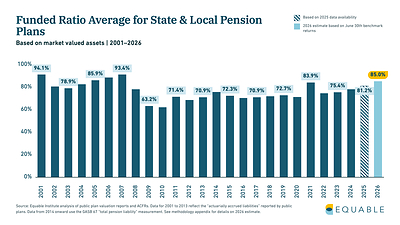
Four straight years of above-target investment returns have lifted the national funded ratio to 85%, according to Equable Institute's 7th annual State of Pensions report.
NEW YORK, July 23, 2026 /PRNewswire/ -- America's state and local pension systems are in their strongest funded position since 2009, according to State of Pensions 2026, Equable Institute's seventh annual analysis of 253 statewide and municipal retirement systems across all 50 states and D.C.
The report finds:
- The national funded ratio is projected to reach 85.0% in FY2026, up 3.9 points from 81.2% in 2025 — the fourth consecutive year of improvement and the best level since 2009.
- Total unfunded liabilities fell to an estimated $1.13 trillion, down from $1.37 trillion in 2025.
- Plans are projected to earn a 9.4% average investment return, beating the 6.9% assumed target for the fourth straight year.
- 45 states improved their funded status and seven are now 100% funded or better.
- Employers now contribute a record 31.83 cents of every payroll dollar to pensions — more than triple the 2001 rate. Only about 9.4 cents covers new benefits.
Beneath the improvement, Equable highlights two key structural risks. The report cautions that pension funds increasingly look alike, making similar investments and owning the same handful of giant companies, which comprise a growing share of the major indices. When markets do well, nearly everyone does well — but the same bets mean a single downturn could drag almost all of them down at once. Adding to the risk, more than a quarter of pension money is now invested in assets whose value is estimated rather than set by an open market, the highest level on record. At the same time, valuation risk is also at a record high. More than 27% of pension dollars are now invested in assets whose value is estimated rather than set by an open market, the highest level on record.
That shared bet increasingly runs through artificial intelligence. Equable estimates 8% to 10% of public pension assets — roughly $513 billion to $642 billion — are directly exposed to a basket of A.I.-related companies, likely an undercount given limited transparency in private equity and externally managed holdings.
"Public plans have steadily improved their funding over the last several years thanks to record high contribution rates and steadily positive investment returns," said Equable executive director Anthony Randazzo. "However, many states reporting strong funded status are relying heavily on the accuracy of private equity and real estate valuations. And all states are — intentionally or not — now relying on an A.I.-driven economy to propel them forward and prevent a funded status regression. This is a better position for the country than year over year increase in unfunded liabilities, but there is no guarantee this recovery progress will persist."
To read the State of Pensions 2026, access interactive data visualizations, and download raw data, visit: equable.org/stateofpensions2026.
About Equable Institute
Equable Institute is a bipartisan nonprofit dedicated to making public retirement systems work. We sit at the intersection of retirement policy and broader public policy, equipping policymakers, public employees, and retirement plan managers with independent, data-driven research, analysis, and education.
Equable.org | Twitter: @EquableInst | Facebook: @EquableInstitute | Instagram: @EquableInst
 View original content to download multimedia:https://www.prnewswire.com/news-releases/equable-institute-analysis-us-public-pensions-reach-best-funded-status-since-2009--but-remain-1-13-trillion-short-302832640.html
SOURCE Equable Institute


