Pusan National University Study Rethinks How Household Income Needs Are Assessed for Welfare Support
PR Newswire
BUSAN, South Korea, Sept. 10, 2026
New research shows that household composition, consumption needs, and benefit objectives can influence how income support should be adjusted
BUSAN, South Korea, Sept. 10, 2026 /PRNewswire/ -- How much more income does a two-person household need than a person living alone? The answer is not simply twice as much. Two people need more food and other necessities, but they can also share expenses such as housing. This means that as a household grows, the income needed to maintain the same standard of living increases—but usually by less than the number of people in the household.
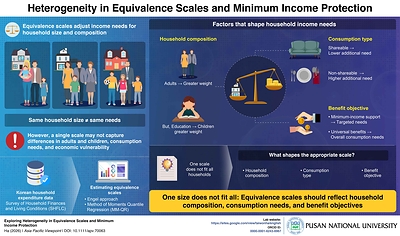
Measuring this difference is important for welfare policy because governments need to decide how income thresholds and benefit levels should change according to household characteristics. The measure used to make these adjustments is known as an "equivalence scale." Yet household size alone may not tell the whole story. Two households with the same number of people may have different needs depending on whether their members are adults or children and on what they consume.
Dr. Taiwon Ha, an Assistant Professor of Public Administration at Pusan National University, examined these differences using Korean household data. His study explores how household composition and consumption type influence equivalence scales, providing insights for the design of minimum-income protection and other public transfer programs. This paper was made available online on July 8, 2026, and was published in Asia Pacific Viewpoint.
The findings showed that the empirical equivalence scales were generally smaller than the old OECD scale, a commonly used benchmark for adjusting household income. The study also found that additional adults generally required greater weights than additional children. Education expenditure was an important exception, however, as children generated relatively greater additional needs in this category.
The type of consumption also mattered. Non-shareable goods, like food, which must largely be consumed individually, were associated with larger equivalence scales than shareable goods, such as housing. This suggests that the amount of additional income a household needs depends not only on how many people live together, but also on the kinds of goods and services they need.
These findings could have direct implications for Korea's National Basic Livelihood Security system, whose standards serve as benchmarks for various welfare benefits. Policymakers could use more differentiated equivalence scales when determining income eligibility and benefit levels. For example, minimum-income programs may assign greater weight to adults, while education-related assistance could better reflect the substantial costs associated with children. More broadly, the appropriate equivalence scale may differ depending on the objective of the benefit program.
Refining equivalence scales to better reflect actual household needs could contribute to a more precise and responsive social protection system. Such an approach could improve the effectiveness and fiscal efficiency of minimum-income protection by allowing benefit adjustments to better reflect differences in household composition, consumption needs, and policy objectives.
Finally, Dr. Ha concludes, "One size does not fit all when it comes to household income needs. We hope this research can provide practical evidence for designing a more responsive social protection system that better reflects household differences and directs support to those who need it most."
Reference
Title of original paper: Exploring Heterogeneity in Equivalence Scales and Minimum Income Protection
Journal: Asia Pacific Viewpoint
DOI: https://doi.org/10.1111/apv.70063
About Pusan National University
Website: https://www.pusan.ac.kr/eng/Main.do
Media Contact:
Goon-Soo Kim
82 51 510 7928
422260@email4pr.com
 View original content to download multimedia:https://www.prnewswire.com/news-releases/pusan-national-university-study-rethinks-how-household-income-needs-are-assessed-for-welfare-support-302875026.html
SOURCE Pusan National University


