Reengineering Start of Care: IO Health Launches ioDoc, Eliminating Manual Documentation at the Point of Care
PR Newswire
PASADENA, Calif., April 1, 2026
Real-world data from GrandCare Health confirms 30+ minutes saved per visit and $30+ reduced per episode
PASADENA, Calif., April 1, 2026 /PRNewswire/ -- IO Health, a health technology company serving U.S. home health and hospice agencies, today announced the commercial availability of ioDoc™, a digital patient documentation solution that eliminates manual handbook creation at Start of Care (SOC). Simultaneously, the company is releasing operational outcome data from GrandCare Health, a multi-location home health agency that completed full implementation across 120 clinicians, confirming measurable reductions in visit time, administrative labor, and per-episode cost.
Start of Care visits are among the most documentation-intensive moments in home health. In most agencies, patient handbooks are still printed, manually assembled, and carried into the home by clinicians, then mailed or re-delivered when information changes. The process is fragmented, difficult to audit, and expensive to sustain.
ioDoc™ replaces this workflow entirely. By generating patient-specific documentation directly from the agency's existing EMR and delivering it electronically, ioDoc™ removes manual preparation before the visit, eliminates printed materials, and creates a complete, timestamped delivery audit trail for compliance.
The Documentation Burden in Home Health
The issue is not documentation itself, but how it is handled. In most agencies, documentation is created, managed, and corrected across multiple stages. Before the visit, materials are prepared manually. During the visit, clinicians manage both care and documentation. After the visit, corrections and redistribution are common.
Because these steps are interconnected, inefficiencies compound. Preparation introduces inconsistencies, which lead to follow-up work and QA intervention. Over time, this results in longer visits, more after-hours documentation, and higher operational burden. GrandCare's pre-implementation workflow followed this same pattern, with documentation repeatedly handled across stages and requiring ongoing correction.
For a mid-size agency running 300 Start of Care visits per month, manual handbook prep alone consumes roughly 150 staff hours. That is time not spent on patient care, not recoverable through scheduling, and invisible on most operational dashboards, because it has always been there.
GrandCare Health Outcome Data
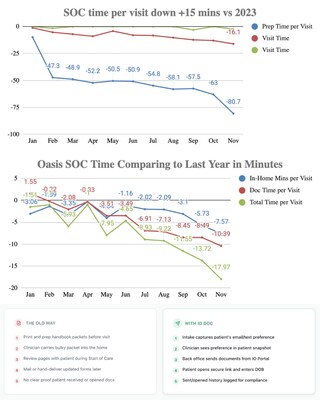
At GrandCare, the improvement compounded over time. SOC visit time dropped progressively from January through November, suggesting that clinicians were not just completing the same work faster, but changing how they worked. By November, total visit time was down nearly 18 minutes versus the prior year baseline. That trend has continued to improve with each month of adoption. GrandCare Health began implementation of ioDoc™ in January 2024, completing full rollout across all 120 clinicians by April. Operational data collected through November 2024 showed:
- SOC visit time decreased by more than 15 minutes per visit, without changes to clinical requirements
- Handbook preparation time dropped from 30+ minutes to approximately 3 minutes
- Per-episode administrative cost decreased by $30 or more, driven by eliminated printing and labor
- 100% of patient document deliveries are now timestamped and logged, creating a complete compliance audit trail
- Non-value-added work per visit declined significantly, reflecting a reduction in total effort, not a redistribution of it
The improvement compounded over the course of the year. Total visit time continued to decline month over month, suggesting that clinicians were not simply completing the same work faster, but fundamentally changing how the visit was conducted.
Operational Impact Across the Episode
Because Start of Care is a high-effort, high-frequency process, improvements at this stage extend across the entire episode. Reducing preparation time lowers hidden clinician workload. Shorter visits improve scheduling capacity. Fewer inconsistencies reduce QA intervention and post-visit corrections. These changes are not isolated to admission. Other visit types also show reduced documentation-related time, indicating a broader workflow improvement.
"I founded IO Health while I was still CEO of GrandCare Health, because I was living this problem every day. I watched skilled clinicians spend their mornings printing handbooks, carrying binders into patients' homes, and then scrambling to re-deliver updated paperwork days later. It was a workflow built for a different era, and it was quietly draining time and money from every single visit. I built ioDoc because I knew it didn't have to be that way, not for GrandCare, and not for any agency or clinician still dealing with the same thing."
— David Bell, Ph.D., Founder & CEO, IO Health
Financial and Patient Experience Implications
Operational changes translate directly into financial outcomes. Reduced manual work lowers labor costs. Eliminating printing reduces per-episode expenses. More consistent documentation supports faster billing and fewer delays. At the same time, patients receive documentation in a format they increasingly expect: digital, accessible, and current. These effects reinforce each other. Improved accuracy reduces rework, lowering cost and improving revenue predictability while improving clinician and patient experience.
What does this actually cost your agency?
An agency completing 300 Start of Care visits per month, a mid-size operation, loses an estimated 150 staff hours every month to manual handbook preparation alone. At a blended clinician rate of $35/hour, that is $5,250 in non-billable labor. Add printing and supply costs averaging $30 per episode, and you are looking at $14,250 in avoidable monthly spend. That is $171,000 per year removed from your margins before a single QA correction is counted.
ioDoc eliminates that cost; not reduces it, instead eliminates it.
Compliance risk is also reduced. Agencies using paper-based workflows have no reliable proof that patients received or opened required documents. ioDoc creates a full delivery audit trail, every document sent, every document opened, logged automatically. In a survey environment, that is the difference between a finding and a clean record.
Availability
ioDoc™ is available now for home health agencies. It is compatible with any EMR. Implementation is measured in days, not months. Agencies interested in a workflow review can visit iohealth.ai
Inefficiencies in Start of Care documentation are not inherent to the process. They are the result of workflows that require repeated manual handling of the same information. By removing manual handbook creation, io Doc™ reduces total workload, shortens visits, and improves consistency without changing clinical requirements.
For leadership, the implication is straightforward: improving documentation is not about asking clinicians to do more. It is about removing unnecessary work from a process that has remained unchanged for too long. The question for your leadership team is not whether this improvement is achievable, GrandCare's data shows it is. The question is how long your agency will continue absorbing a cost that already has a solution.
See What This Looks Like in Your Workflow
If your team is still preparing SOC binders manually, reworking documentation after visits, or relying on paper handoffs with no delivery confirmation, this is already costing you time and margin.
ioDoc is compatible with any existing EMR. No workflow changes. No new system to learn. Implementation is measured in days, not months.
Schedule a 30-minute workflow review at iohealth.ai
 View original content to download multimedia:https://www.prnewswire.com/news-releases/reengineering-start-of-care-io-health-launches-iodoc-eliminating-manual-documentation-at-the-point-of-care-302730455.html
SOURCE io Health


